
Now, my own suspicion is that the universe is not only queerer than we suppose, but queerer than we can suppose. I have read and heard many attempts at a systematic account of it, from materialism and theosophy to the Christian system or that of Kant, and I have always felt that they were much too simple. I suspect that there are more things in heaven and earth than are dreamed of, or can be dreamed of, in any philosophy.
– J. B. S. Haldane
Haldane was a funny and annoying non-conformist who worked in physiology, genetics, evolutionary biology, philosophy, politics, and mathematics at the beginning of the 20th century. I find him to be a very original thinker. He, as Walt Whitman, and as myself, accept all philosophies as our philosophy, as we cannot take absolute positions on anything. My philosophy must be the sum of all philosophies and acknowledges that we can’t, nor need to, know it all. We each need just enough. I think wisdom is learning to need less and less. We have to keep an open mind and can’t just trust our senses to tell us the whole story. Our senses are limited, as are our minds. Is the mind just physical? What about dreams? Are dreams just caused by atoms bouncing around in our heads? Are dreams another way of knowing beyond our senses?
Whatever I have accepted until now as most true has come to me through my senses. But occasionally I have found that they have deceived me, and it is unwise to trust completely those who have deceived us even once.
– Rene Descartes
I’ve been studying the alphabet and it’s affect on us over time. Some ancient Greeks noted the limitations of written language. One of the most famous articulations of skepticism towards writing comes from Plato, specifically in his dialogues “Phaedrus” and “The Seventh Letter.” In “Phaedrus,” Plato’s character Socrates raises concerns that written words cannot defend themselves in dialogue and are therefore inferior to spoken words. He describes writing as an invention that will produce forgetfulness because people will rely on external written characters and not remember of themselves. Socrates goes on to say that written words “seem to talk to you as though they were intelligent, but if you ask them anything about what they say, from a desire to be instructed, they go on telling you just the same thing forever” (Plato, “Phaedrus” 275d).
In “The Seventh Letter,” Plato expresses skepticism about writing philosophic truths, arguing that they can only be truly understood through direct, personal instruction. The context here is primarily the transmission of philosophic and esoteric knowledge, and the concern is that writing can distort or trivialize these deeper truths. Ironically, Plato himself chose to write extensively, so his views were not an outright rejection of written language but rather a nuanced critique of its limitations.
I have also been looking into Epicureanism and its modern adherents. I wondered how they interpret quantum physics in relation to their atomistic views. The best they have come up with apparently about whether anything other than atoms exist is…I don’t know. I don’t ultimately know either. How then shall we best live? The pragmatic view is to work with what you can know and don’t sweat the rest, but there is that part of us that dreams. We are the dreamers of dreams. That is a kind of knowing too. We can’t fully trust our senses especially knowing our brains make up things to fill in a picture that has evolved to keep us alive in this environment. It doesn’t give us the full picture. There is much talk about waking up from the dream in esoteric and mindfulness circles. I think this not quite right. We don’t wake up, we can enter the dream consciously, we can lucidly dream this world. Wakefulness is just a state of mind to get things done.
Consider the Zhuangzi paradox.
He who dreams of drinking wine may weep when morning comes; he who dreams of weeping may in the morning go off to hunt. While he is dreaming he does not know it is a dream, and in his dream he may even try to interpret a dream. Only after he wakes does he know it was a dream. And someday there will be a great awakening when we know that this is all a great dream. Yet the stupid believe they are awake, busily and brightly assuming they understand things, calling this man ruler, that one herdsman—how dense! Confucius and you are both dreaming! And when I say you are dreaming, I am dreaming, too. Words like these will be labeled the Supreme Swindle. Yet, after ten thousand generations, a great sage may appear who will know their meaning, and it will still be as though he appeared with astonishing speed.
– Zhuangzi
Welcome to the “Great Dream.” We barely know ourselves. It is as if we have just awoken on the shore after a shipwreck and we have barely blinked our eyes while looking up at the bright sun in the sky. Perhaps our world is not “the best of all possible worlds” as Gottfried Leibniz surmised, but “the best of all possible stories.” Are the people of the alphabet an improvement on the people of the spoken word? Maybe not. Our letters and numbers seem to have gotten us in all sorts of trouble.
I just finished the book, The Spell of the Senuous: Perception and Language in a More-Than-Human World https://projects.iq.harvard.edu/files/retreat/files/abram_the_spell_of_the_sensuous_perception.pdf – https://www.amazon.com/dp/0679776397?ref_=cm_sw_r_apin_dp_NMPR3F4DZ3G1EAZ9AVYJ
The initiatory “Walkabout” undertaken by Aboriginal Australians is again just such an act whereby oral peoples turn toward the more-than-human earth for the teachings that must vitalize and sustain the human community.
In indigenous, oral cultures, nature itself is articulate; it speaks. The human voice in an oral culture is always to some extent participant with the voices of wolves, wind, and waves— participant, that is, with the encompassing discourse of an animate earth. There is no element of the landscape that is definitively void of expressive resonance and power: any movement may be a gesture, any sound may be a voice, a meaningful utterance.
– David Abram – The Spell of the Sensuous
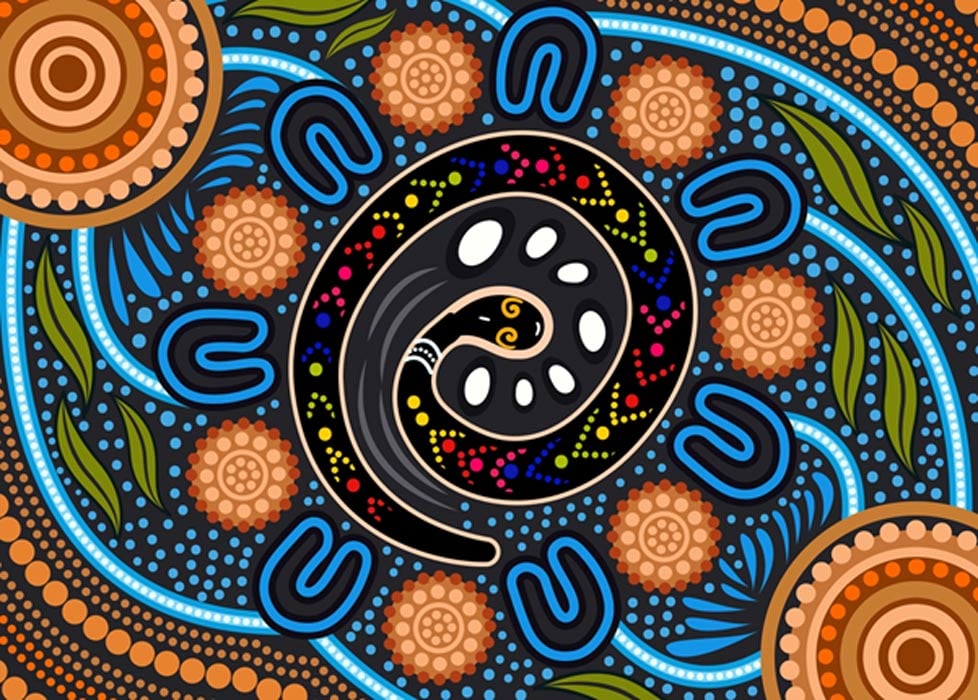
The Dreamtime is a commonly used term for describing Aboriginal spiritual beliefs and existence. It is not generally well understood by non-indigenous people.
Aboriginals believe that the Dreamtime was way back, at the very beginning. The land and the people were created by the Spirits. They made the rivers, streams, water holes the land, hills, rocks, plants and animals. It is believed that the Spirits gave them their hunting tools and each tribe its land, their totems and their Dreaming.
The Aboriginals believe that the entire world was made by their Ancestors way back in the very beginning of time, the Dreamtime. The Ancestors made everything. Aboriginal people understood the Dreamtime as a beginning that never ended. They held the belief that the Dreamtime is a period on a continuum of past, present and future.
Voltaire shredded Leibniz’s optimistic belief that this was “the best of all possible worlds” based on his belief in divine providence, by pointing to real-world tragedies and hardships. But my idea that this is “the best of all possible stories” leans into a narrative understanding of life, part of a bigger story of life. This is how the people of the word make sense of their world and experiences. We can make sense of our individual lives through our own stories, which are based on our experience. We also have our family, ethnic, societal, planetary, and cosmic stories. We have metaphorical maps and scientific ones to use to interpret our experiences, but we should consider all the maps. The existentialists feel we create meaning, we don’t find it. The ‘story’ may be more ‘real’ to us than the underlying events. The Many Worlds hypothesis takes this to extremes.
That we might be living in “the best of all possible stories” takes into account not only the good, but also the suffering, chaos, and randomness that define human experience. Each of these elements contributes to a dynamic narrative, and perhaps it’s through engaging with this narrative that individuals and societies can find meaning, growth, or redemption. The ‘best’ story wouldn’t necessarily mean the most utopian, sustainable, or pain-free, but rather the one that leads to the most profound understanding, the most intense experience of what it means to be alive—even if that involves struggle, conflict, and suffering. It’s a narrative that, like any great story, has room for both triumph and tragedy.
 The Tripping Fool