
Through recorded history our species has waffled between seeing our world as divinely created and inspired and the belief that we exist alone in a brutal universe and that all we have is each other, so make the best of it. The ancients moved from mythology to philosophy. Science today has moved beyond philosophy and religion to observation of matter. It seems we have always waffled between love and strife. Our world today is divided along these lines, as in the ancient world. The author of “On the Nature of Things,” Lucretius (c. 99—c. 55 B.C.E.), a Roman poet and philosopher, was an Epicurean and contributed toward our science today. He offered a naturalistic view of the world, emphasizing the pursuit of mental and physical well-being and the importance of understanding nature to alleviate human fears and anxieties. Here are some of his key ideas.
- Materialism and Atomism: Everything in the universe, including the soul, is made up of tiny, indivisible particles called atoms. These atoms move through the void (empty space) and combine in various ways to form all the objects and phenomena we observe.
- Mechanistic Universe: There is no divine intervention in the cosmos. The movement and interactions of atoms are governed by natural laws. Natural phenomena, such as thunder and lightning, are not the actions of angry gods but rather the result of atomic interactions.
- Death is Natural and Not to Be Feared: Humans, like everything else, are made up of atoms. When we die, these atoms simply disperse and are reused in other forms. The soul does not survive death. Since consciousness ends with death, there’s no afterlife to fear or hope for. This perspective encourages people to focus on the present and live a pleasurable and virtuous life.
- Pursuit of Pleasure and Avoidance of Pain: The goal of life, according to Epicurean philosophy, is to attain pleasure and avoid pain. However, this doesn’t mean indulgence in immediate sensual pleasures. Instead, it often refers to the pleasures of the mind, like friendship and knowledge, and the absence of physical pain and mental distress.
- Critique of Religion: Lucretius strongly criticized traditional religious beliefs, considering them a source of fear and superstition that brought unnecessary pain and suffering. He believed understanding the natural world and its workings could dispel these fears.
- Peace of Mind (Ataraxia): By understanding the nature of the universe and our place in it, we can achieve ataraxia, or a tranquil and undisturbed mind. This inner peace is considered one of the highest forms of pleasure in Epicurean philosophy.
Parmenides of Elea (c. 515 – 450 BCE) was a pre-Socratic philosopher whose work laid foundational ideas for the development of Western philosophical thought, particularly regarding metaphysics. He proposed that though the world appeared to be composed of multiple separate things, the world is an actually an indivisible one and that change was an illusion. He felt a human’s sensory perception was greatly lacking. He was not the first to think this way. He was the first recorded Human Being that felt reason alone could reach higher truths with no physical evidence. This became he foundation of Plato’s philosophy. His primary surviving work is a poem, often referred to as “On Nature.” Here’s a summary of Parmenides’ key ideas:
- The Way of Truth vs. The Way of Opinion: Parmenides distinguishes between two paths of inquiry: the Way of Truth and the Way of Opinion. The former refers to the realm of what is unchanging and eternal, while the latter pertains to the realm of change and multiplicity, which Parmenides considers illusory or deceptive.
- Being is Unchanging: Parmenides argues that “what is” (Being) is unchanging, eternal, indivisible, and homogenous. Change, plurality, and non-being (or nothingness) are logically impossible. For him, the fact that we speak of something means it exists; thus, non-being cannot be spoken of meaningfully.
- Arguments Against Non-being: Parmenides suggests that speaking of non-being (or nothingness) is a contradiction. If you speak of it, it exists in some sense, making it “being.” Therefore, nothingness or non-being is an impossible concept.
- Critique of Sensory Perception: Trusting sensory perceptions can mislead us, according to Parmenides. Our senses tell us the world is full of change and multiplicity, but reason tells us the opposite: that true reality (Being) is unchanging and one.
- Influence on Later Philosophers: Parmenides’ ideas on the nature of Being significantly influenced later philosophers, especially Plato. The dialogue between young Socrates and Parmenides in Plato’s “Parmenides” explores and critiques these ideas in-depth.
In essence, Parmenides challenged the traditional views of reality held by earlier thinkers. He argued for a monistic and unchanging reality, in contrast to the apparently changing and diverse world presented by our senses. His emphasis on reason and logic over sensory perception, laid important groundwork for later philosophical inquiries into the nature of reality.
Also in the 5th century, Heraclitus the obscure, said the world was made up of a permanent flux of opposite forces, panta rhei, everything flows. “No man ever steps in the same river twice, for it’s not the same river and he’s not the same man.” He thought an eternal impersonal being called Logos, word and reason, reigned over all things untouched and unmoving. “Setting out for the bounds of the soul, you would not find them out, though you passed along every way, so deep a logos does it have.” The logos of the soul, like the logos of nature, is boundless. We can go to the depths of our souls and never touch bottom. Though they appear to think about being very differently, Parmenides and Heraclitus agreed on rejecting the anthropomorphic characteristics attributed to the Gods in mythology and poetry. Parmenides felt poets were dangerous and tempted the mind to grasp to illusions. Heraclitus was skeptical of poets as well and said they could write beautiful and seductive words, but offered false and deceiving truths.
Xenophanes also thought the myths were just anthropomorphic nonsense and that if horses could draw, they would draw the Gods as a horse. We create the Gods in our image. Empedocles rejected he old myths as well and said “God is a circle whose center is everywhere, and its circumference nowhere.” God is only mind.
“We cannot bring God near so as to reach him with our eyes and lay hold of him with our hands. . . . For he has no human head attached to bodily members, nor do two branching arms dangle from his shoulders; he has neither feet nor knees nor any hairy parts. No; he is only mind, sacred and ineffable mind, flashing through the whole universe with swift thoughts.”
“Weak and narrow are the powers implanted in the limbs of men; many the woes that fall on them and blunt the edge of thought; short is the measure of the life in death through which they toil. Then are they borne away; like smoke they vanish into air; and what they dream they know is but the little that each hath stumbled upon in wandering about the world. Yet boast they all that they have learned the whole. Vain fools! For what that is, no eye hath seen, no ear hath heard, nor can it be conceived by the mind of man.“
Empedocles focused on love and strife as the two basic forces at work in the cosmos. He appears to have been familiar with Zoroastrianism, which dualistically characterized the world as a battle ground between good and evil. There were many mystical sects that arose to find answers to the problems of life. Mystery derives from a word that means keep the mouth shut. The idea arose that we are trapped in matter and something eternal in us longs to return home. The stage was set for Christianity 2000 years ago when it arose and it borrowed heavily from ideas that had come before.
I really like Walt Whitman’s take on all these contradictory ists and isms, a mystic and ecstatic. Don’t go all in with any particular view of being. One must take it all in, all of humanity are our relations.
“I perceive that sages, poets, inventors, benefactors, lawgivers, are only those who have thought.
Who thinks the amplest thoughts? For I will surround those thoughts,
I know all and expose it.
Including all philosophies, as I do, how could I nail myself to any one or single specimen?
Except it be this, only—that my philosophy is to include all other philosophies, hospitable to all forms of thought.
(I am not Anarchist, not Methodist, not anything you can name, yet I see why all the ists and isms and haters and dogmatists exist, can see why they must exist and why I must include all.)“
I feel we have lost something in the West as our thoughts have evolved. Mitákuye Oyás’iŋ (pronounced Mee-tah-koo-yay O-yah-seen) is a phrase from the Lakota language, which translates to “All Are Related” or “We are all related.” This phrase encompasses a core worldview of many Indigenous cultures, especially among the Lakota Sioux people, and emphasizes the interconnectedness and interdependence of all living things. It represents a holistic view of life and the universe, suggesting that everything exists in a system of balance and unity.
The belief behind Mitákuye Oyás’iŋ underscores the idea that every action has a wider impact and that human beings should live in harmony with nature, each other, and their surroundings. This concept of unity and connectedness extends not just to other humans, but to animals, the earth, the sky, and even the unseen forces of the universe.
When someone invokes Mitákuye Oyás’iŋ, they are acknowledging this deep interrelationship and expressing reverence for the natural world and the broader universe. It serves as a spiritual reminder of the essential unity and interrelation of all existence.
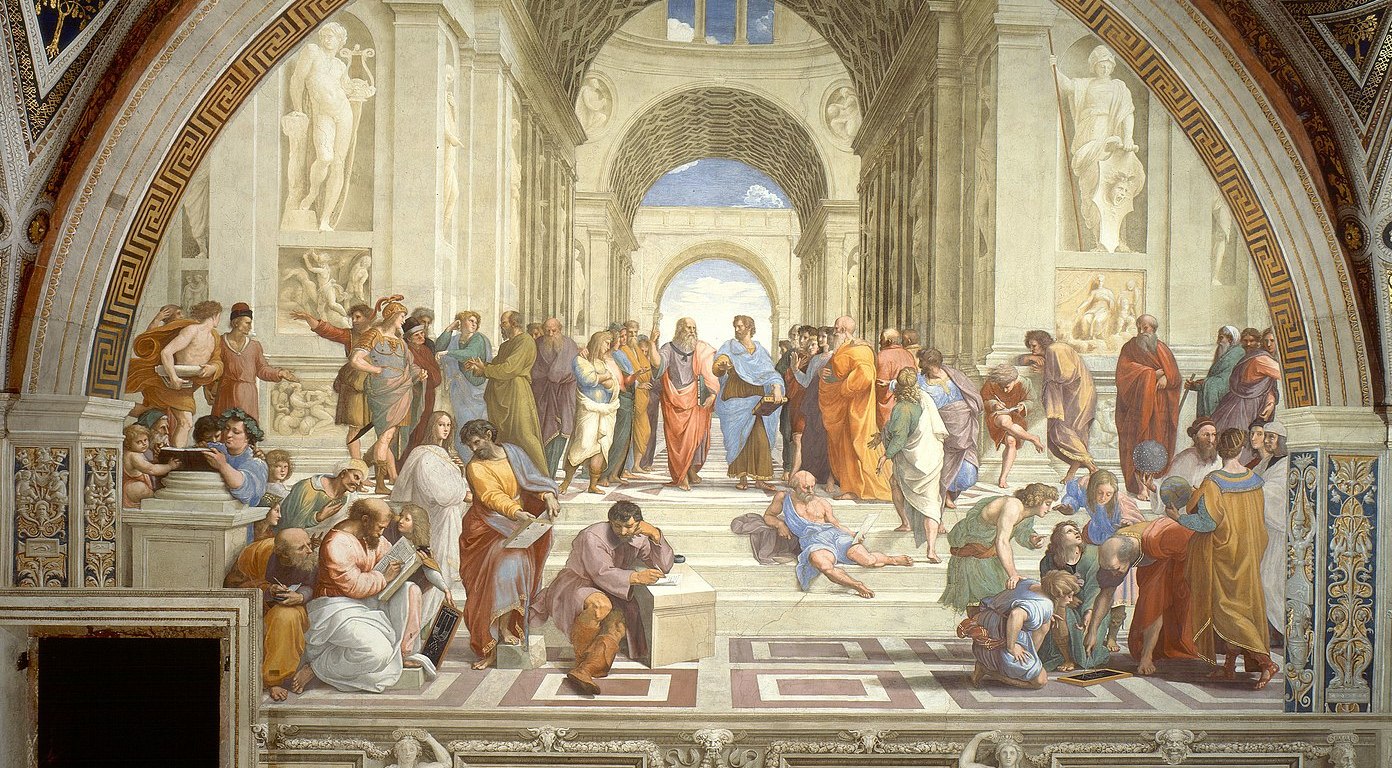
Image: Raphael’s School of Athens

