
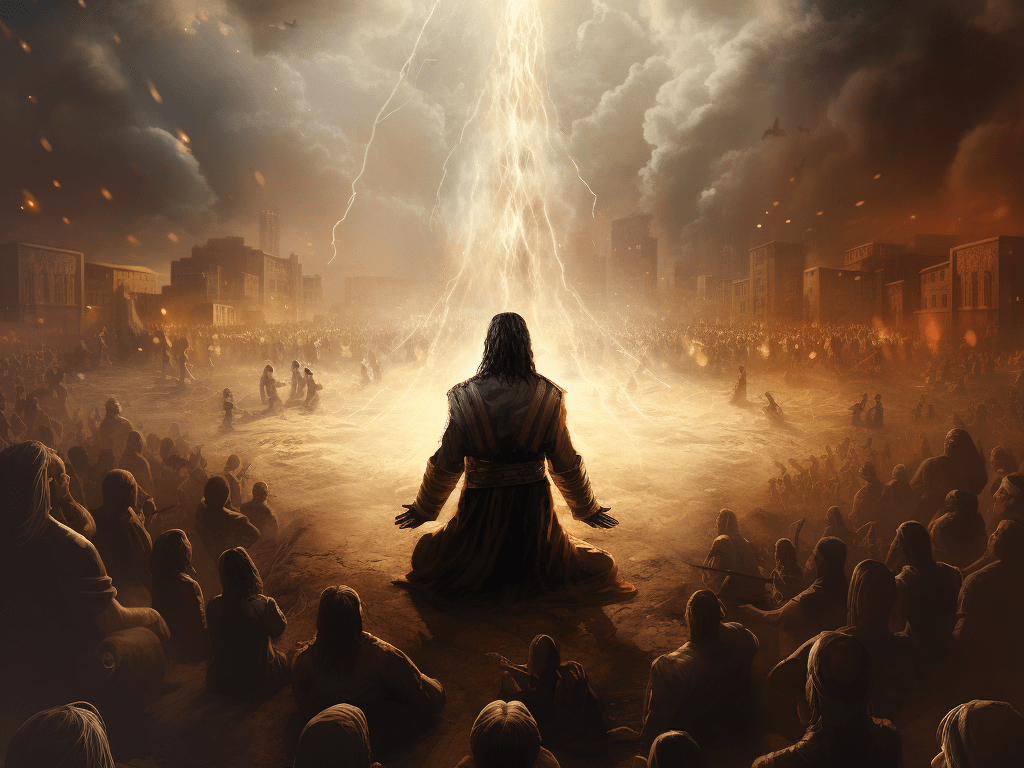
People love to kneel
To kings and queens
To generals and popes
To gods and idols
To equations and teachers
But when one sees through the world
They finally kneel before themselves
Then they stand and embrace all
Who could be your master
When you know yourself
Why are most of us so quick to kneel?
In a world influenced by societal norms and cultural expectations, the act of kneeling can hold various meanings and interpretations. It is a complex phenomenon, deeply rooted in human history and psychology.
One reason why people may be inclined to kneel is fear. Fear of authority, fear of the unknown, fear of consequences. It is a primal instinct, where the instinct to submit and seek protection outweighs the desire to stand tall and assert oneself. Kneeling can provide a temporary relief from the burden of responsibility and the weight of decision-making.
Another possible reason is weakness. Sometimes, life’s challenges can become overwhelming, causing individuals to feel vulnerable and powerless. Kneeling can serve as a gesture of surrender, a way to acknowledge personal limitations and seek support from a higher power or the comfort of a collective belief system. It can be seen as an act of humility, acknowledging that there are forces greater than ourselves.
Moreover, kneeling has long been associated with acts of worship and reverence. Many religious and spiritual traditions incorporate kneeling as a sign of respect and devotion. It symbolizes an individual’s willingness to submit to a higher authority, to express gratitude, and to seek guidance or blessings. Kneeling in such contexts can foster a sense of connection to something divine or transcendent.
However, it is important to note that not everyone adheres to the instinct of kneeling. Some choose to stand tall instead, refusing to submit to external pressures or conform to societal expectations. They value self-reliance, independence, and the pursuit of personal freedom. For them, the act of walking beside, rather than kneeling, represents a determination to carve their own path and question the status quo.
In the end, whether we choose to kneel or stand, the key lies in understanding our motivations and the implications of our actions. It is essential to reflect on the context, values, and beliefs that influence our decisions. And perhaps, in the pursuit of self-discovery and authenticity, we can find a balance between humility and empowerment, between communal unity and individuality.
This year almost brought me to my knees, but as I began to fall, at the last moment before my knee touched earth, I heard a mighty voice shout, “RISE UP,” you are born again! Stand and walk straight on.
Those who know others are clever,
—Tao Te Ching – Chapter 33 – Know Thyself
Those who know themselves are wise.
Those who conquer others are briefly powerful,
Those who conquer themselves are always strong.
Those who know they have enough are rich,
Ambition wanders blind.
Those who stay where they have found their true home flourish.
Our bodies disappear
But the eternal present goes on and on.
A seed that sprouts at the foot of its parent tree remains stunted until it is transplanted… Every human being, when the time comes, has to depart to seek his fulfillment in his own way.
— Vyasa व्यास c. 3000 BCE
Hindu immortals, Vishnu avatar, 5th incarnation of Brahma
from Mahābhārata महाभारतम्
No one saves us but ourselves. No one can and no one may. We ourselves must walk the path.
— Buddha गौतम बुद्ध 563 – 483 BCE
(Siddhartha Shakyamuni Gautama)
Knowing the other and knowing oneself,
In one hundred battles no danger.
Not knowing the other and knowing oneself, one victory for one loss.
Not knowing the other an not knowing oneself, in every battle certain defeat.— Sun Tzu 孙武 544 – 496 BCE (Sun Zi)
Know thyself, for once we know ourselves, we may learn how to care for ourselves… The unexamined life is not worth living.
— Socrates 469 – 399 BCE
The ten thousand things are all within us.
— Mencius 孟子 372 – 289 BCE (Mengzi)
If someone can conquer others, it is only by using force. If someone can conquer their own desires, no one in the world can compete with them. Hence we call them strong.
— Heshang Gong 河上公 202 – 157 BCE
(Ho-shang Kung or “Riverside Sage”)
The kingdom is inside of you, and it is outside of you. When you come to know yourselves, you will realize that it is you who are the sons of the living father. But if you will not know yourselves, you dwell in poverty.
— Jesus 3 BCE – 30 CE
 The Tripping Fool